How much should you charge for your art? A step-by-step guide
Most artists guess. This is the sum instead: add up your costs, pay yourself, allow for the gallery's cut, check the market and keep it consistent. We work through one painting from $200 of materials to a $2,200 price, with the commission rates Australian galleries and art shows actually charge.
You've finished a painting and someone asks what it costs. Most artists guess: a number that feels safe, or what a friend charges. The trouble with guessing is that you can't explain it, you can't repeat it and you usually guess low.
A price you can defend is a sum, not a feeling. Below is a simple five-step method, with one painting worked all the way through, and the commission rates Australian galleries and art shows actually charge.
Quick answers
- The formula: (materials + studio costs + your time) ÷ (1 − commission rate), then check it against the market and round it.
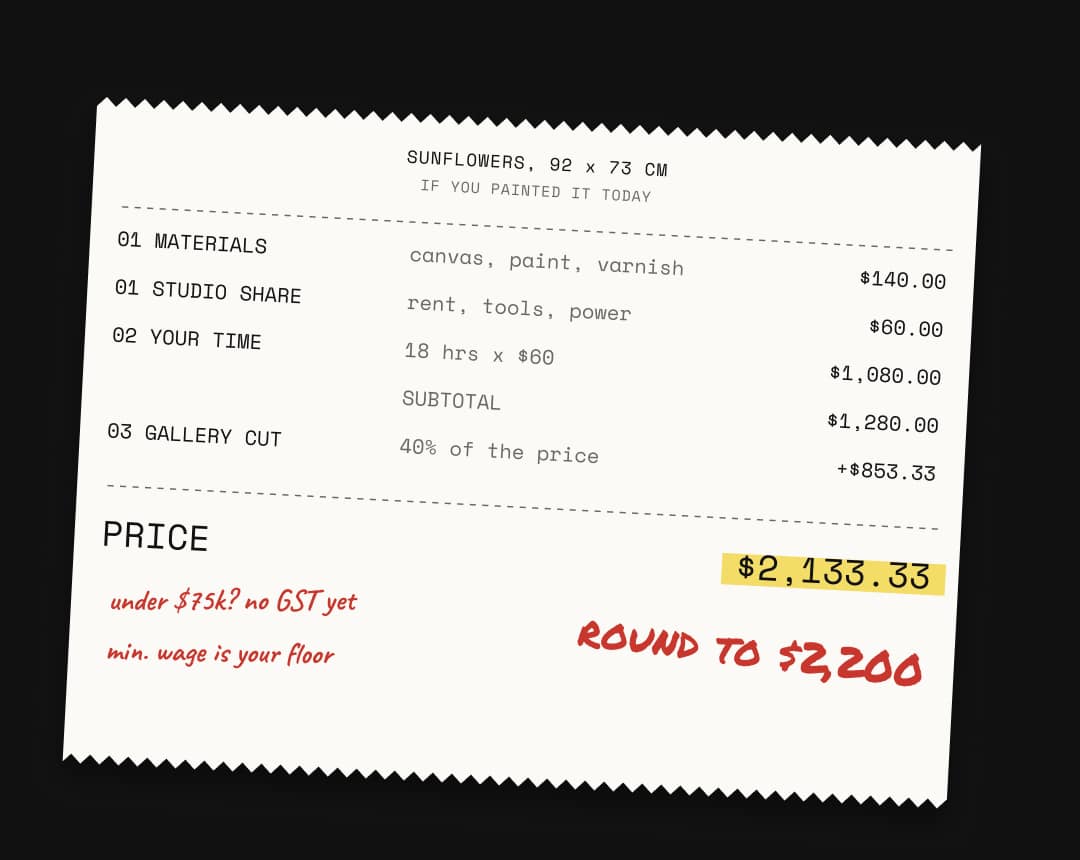
- Our example: $200 of costs + 18 hours at $60 = $1,280. Divided by 0.6 to allow for a 40% gallery cut = $2,133.33. Rounded to $2,200.
- Gallery commission: commercial galleries generally take 40% to 50%, not including GST, according to NAVA. Public galleries take 10% to 40%, sometimes more.
- Art show commission: the shows we checked take 30% to 40%. Camberwell takes 30%, Gosford and Muswellbrook 35%, Lethbridge 40%.
- Your hourly rate: never below the National Minimum Wage, $26.44 an hour from 1 July 2026. Most working artists should be well above it.
- GST: you must register once your turnover hits $75,000 a year. Below that it's optional.
- Never discount in public. Keep one price for each size and medium, wherever you sell.
The worked example
To keep this practical, we've priced one painting the whole way through. Say it's an oil painting about the size of Van Gogh's Sunflowers (92 x 73 cm), and you plan to sell it through a gallery.
- Add up your costs: $140 materials + $60 studio share. Running total $200.
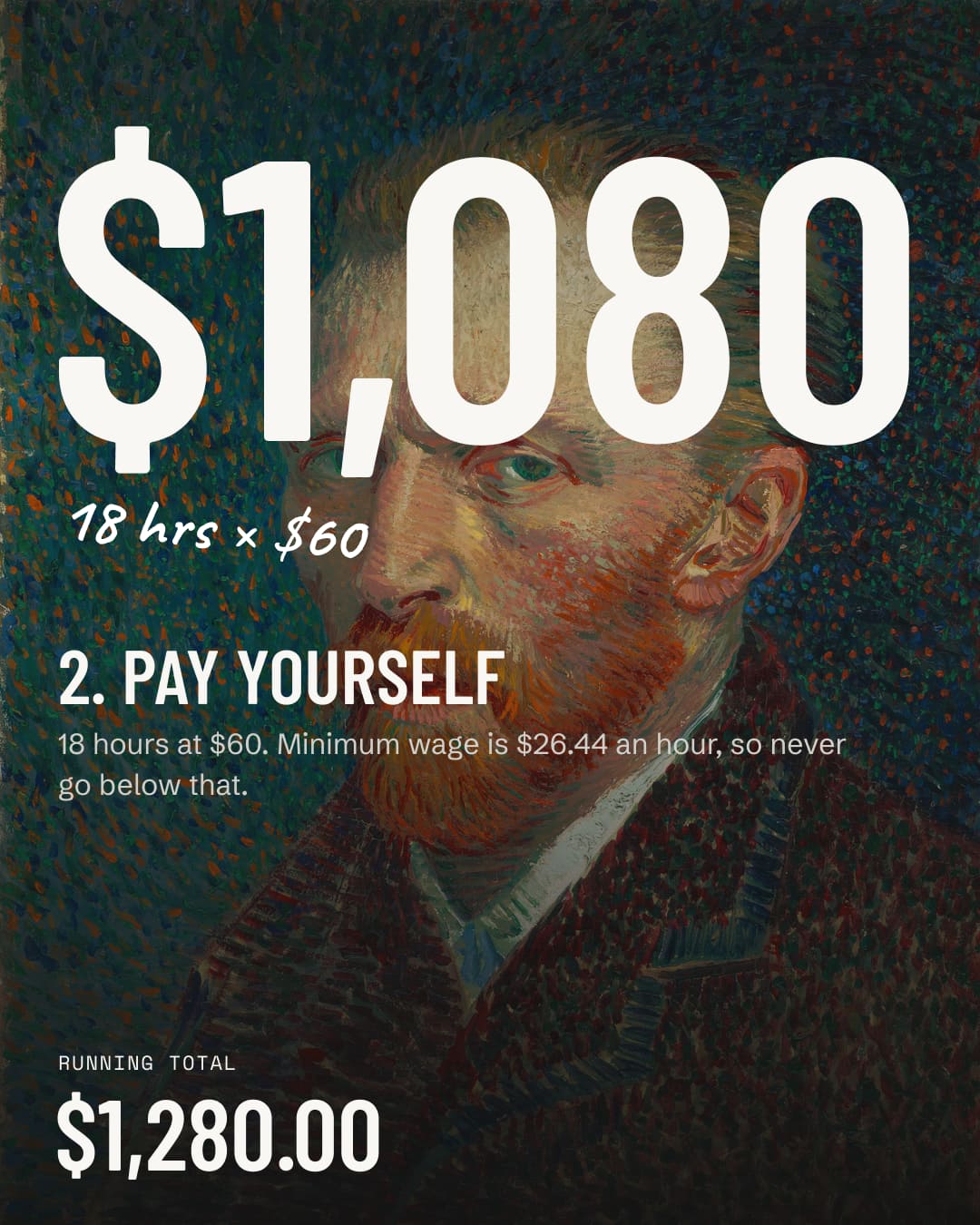
- Pay yourself: 18 hours x $60 = $1,080. Running total $1,280.
- Allow for the gallery's cut: $1,280 ÷ 0.6. Running total $2,133.33.
- Check the market: similar works sell for $2,000 to $2,400. Round to $2,200.
- Keep it consistent: same size and medium, same price. $2,200.
The materials, hours, $60 rate and market range are example figures. Swap in your own. The method stays the same.
Step 1: Add up your costs
Start with what the work costs you to make. NAVA, the National Association for the Visual Arts, lists material costs among the things a retail price should reflect, alongside your experience, past prices and the market.
Count everything that went into the piece:
- Materials: canvas or panel, paint, primer, varnish, paper, clay, film.
- Framing, if you're selling it framed.
- A share of your studio costs: rent, power, tools and equipment that wears out. A simple way is to divide your yearly studio costs by the number of works you make in a year.
- Selling costs: art prize entry fees ($55 to $66 at the Lethbridge prizes, for example) and freight. Many prizes make the artist pay freight both ways.
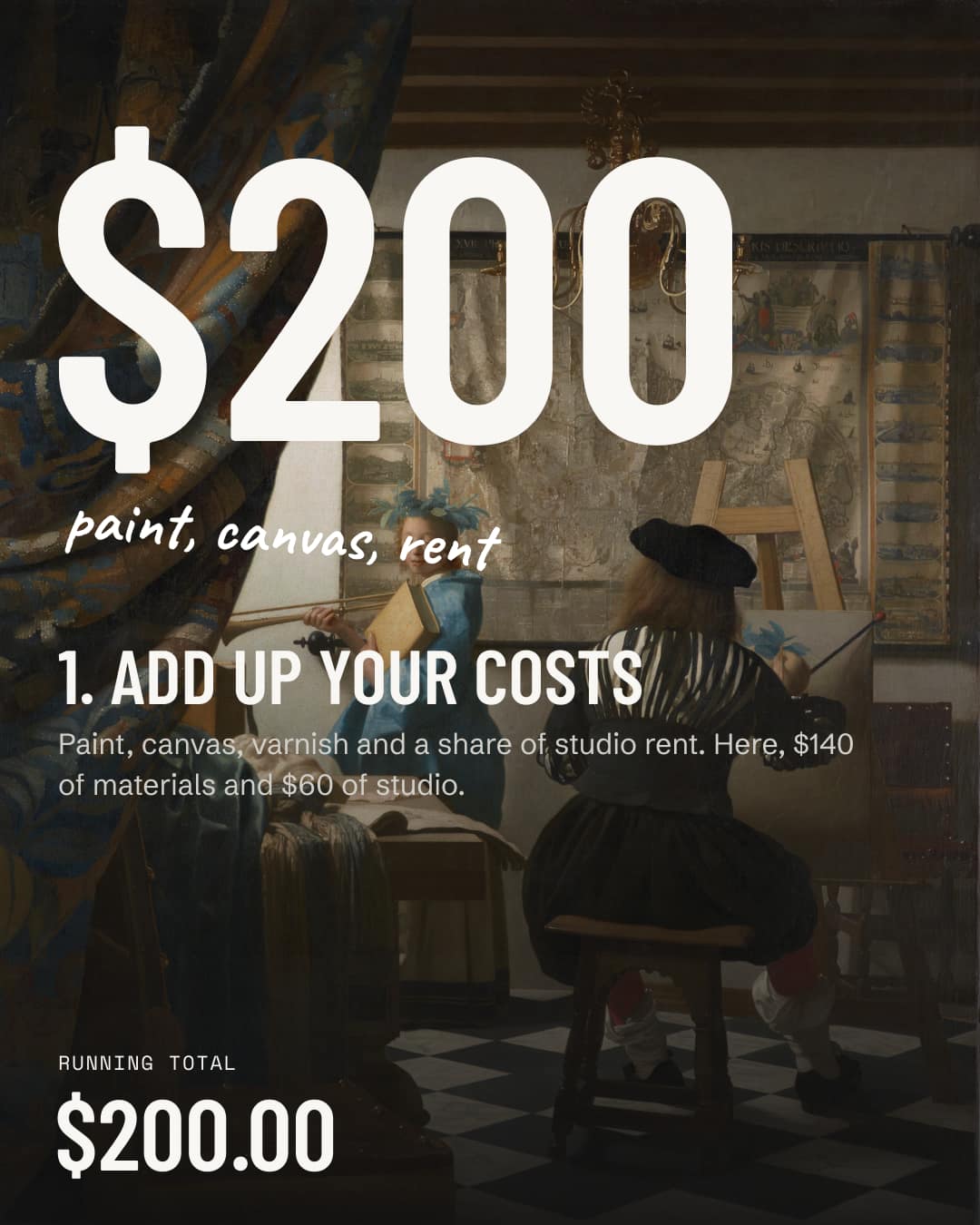
In our example, the painting used $140 of materials and $60 of studio share. Running total: $200.
Step 2: Pay yourself for your time
This is the step most artists skip. NAVA's position is simple: "Artists should be paid for their time, effort, skill and ideas."
Track your hours on every piece, including the planning and the false starts. Then choose an hourly rate. There's no official rate for selling your own work, but there is a floor. The National Minimum Wage is $26.44 an hour (from 1 July 2026), and NAVA uses the minimum wage as the bottom of its own pay scales for artists. If your price works out to less than that per hour, you're paying to make the work.
Most working artists should charge well above the floor, and your rate should grow with your experience, exhibitions and sales. For our example we've used $60 an hour.
18 hours x $60 = $1,080. Running total: $1,280. This is your floor for this painting: the least you should take home.
Step 3: Allow for the gallery's cut
If a gallery, art show or shop sells your work, it keeps a percentage. Price for it before you sell, or the commission comes out of your pay.
The mistake is to add the commission on top of your floor. Adding 40% to $1,280 gives $1,792, and 40% of $1,792 is $716.80, which leaves you $1,075.20. You lose money. Instead, divide your floor by what's left after commission:
- 40% commission: divide by 0.6
- 50% commission: divide by 0.5
- 30% commission: divide by 0.7
$1,280 ÷ 0.6 = $2,133.33. When it sells, the gallery keeps $853.33 and you keep $1,280. Running total: $2,133.33.
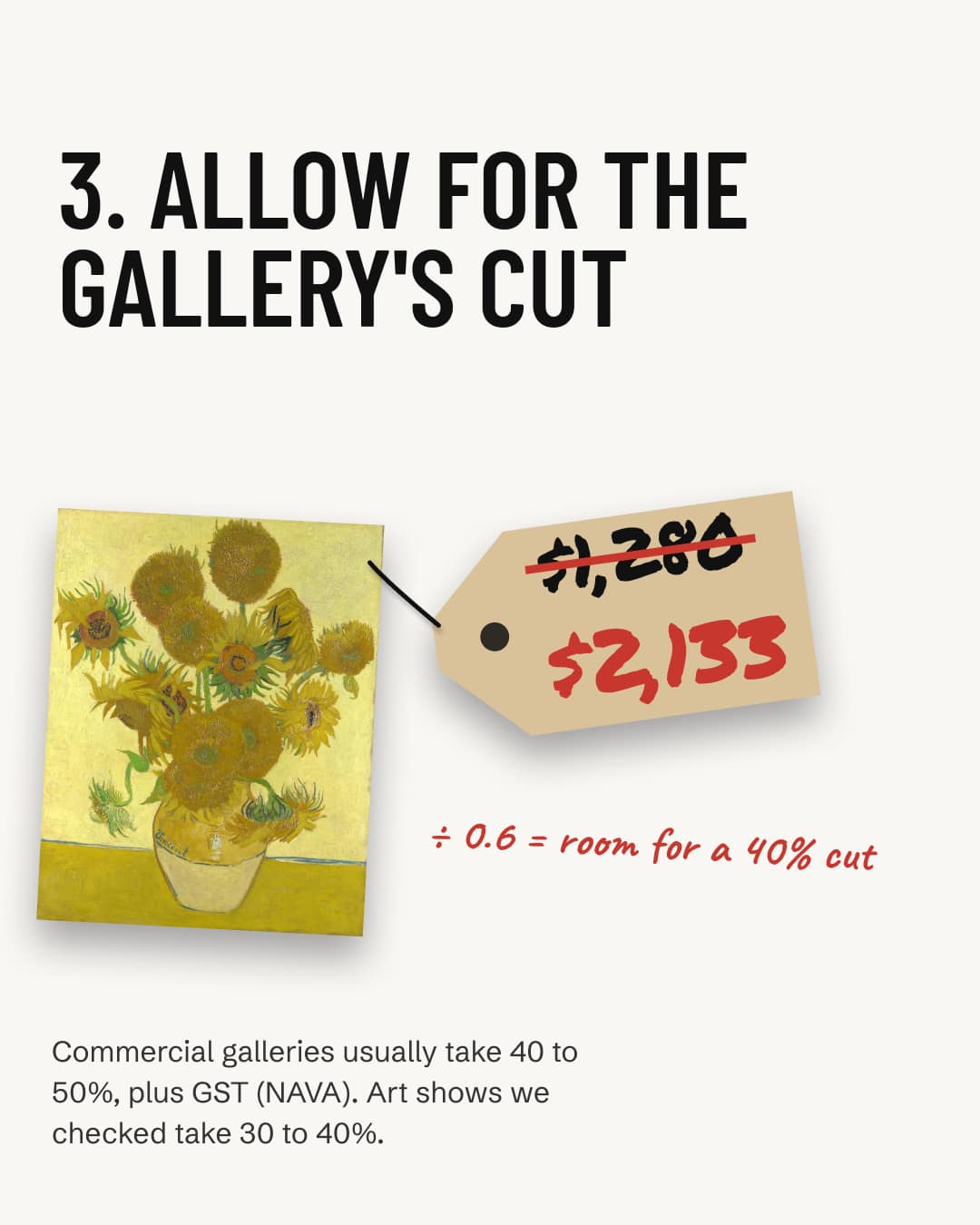
How much commission do galleries take?
Commercial galleries. NAVA's Code of Practice says commission for full representation "generally varies between 40% and 50%, exclusive of GST". It can be higher or lower, depending on the relationship. NAVA recommends a written agreement signed by both of you.
Public galleries (council and state galleries) set their own rates, which NAVA says "can vary from 10% to 40% of the sale price and could be higher".
Art shows and prizes. These are the rates in each show's own terms:
- Camberwell Art Show (Vic): 30%, GST included.
- Gosford Art Prize 2026 (NSW): 35%, GST included.
- Muswellbrook Art Prize 2025/26 (NSW): 35%. Your price must include the commission, plus GST if it applies.
- Lethbridge Small-Scale Art Award 2026 (Qld): 40%.
- Tattersall's Landscape Art Prize 2026 (Qld): 40%.
Notice that some shows include GST in their commission and NAVA's gallery figure doesn't. Always ask which applies. If you're entering prizes, our guide to art prizes in Australia 2027 lists entry fees and dates.
Step 4: Check the market
Your sum tells you the least you can charge. The market tells you what people will pay. NAVA lists "prices of comparable artists" and "market conditions" as part of setting a price.
Find five or so works like yours: similar size, medium and stage of career, sold where you plan to sell. Look at gallery price lists, art show catalogues and artist-run spaces, not just famous names.
- If your sum lands inside their range, you're priced right. Round to a clean number.
- If it's well below, you're underpaying yourself. Price up towards the range.
- If it's well above, you may be early in your career for that price. Look at your costs, your hours or where you're selling, rather than dropping your rate below the floor.
Price independently. Arts Law notes that it's fine to be competitive, but "illegal to fix prices with competitors".
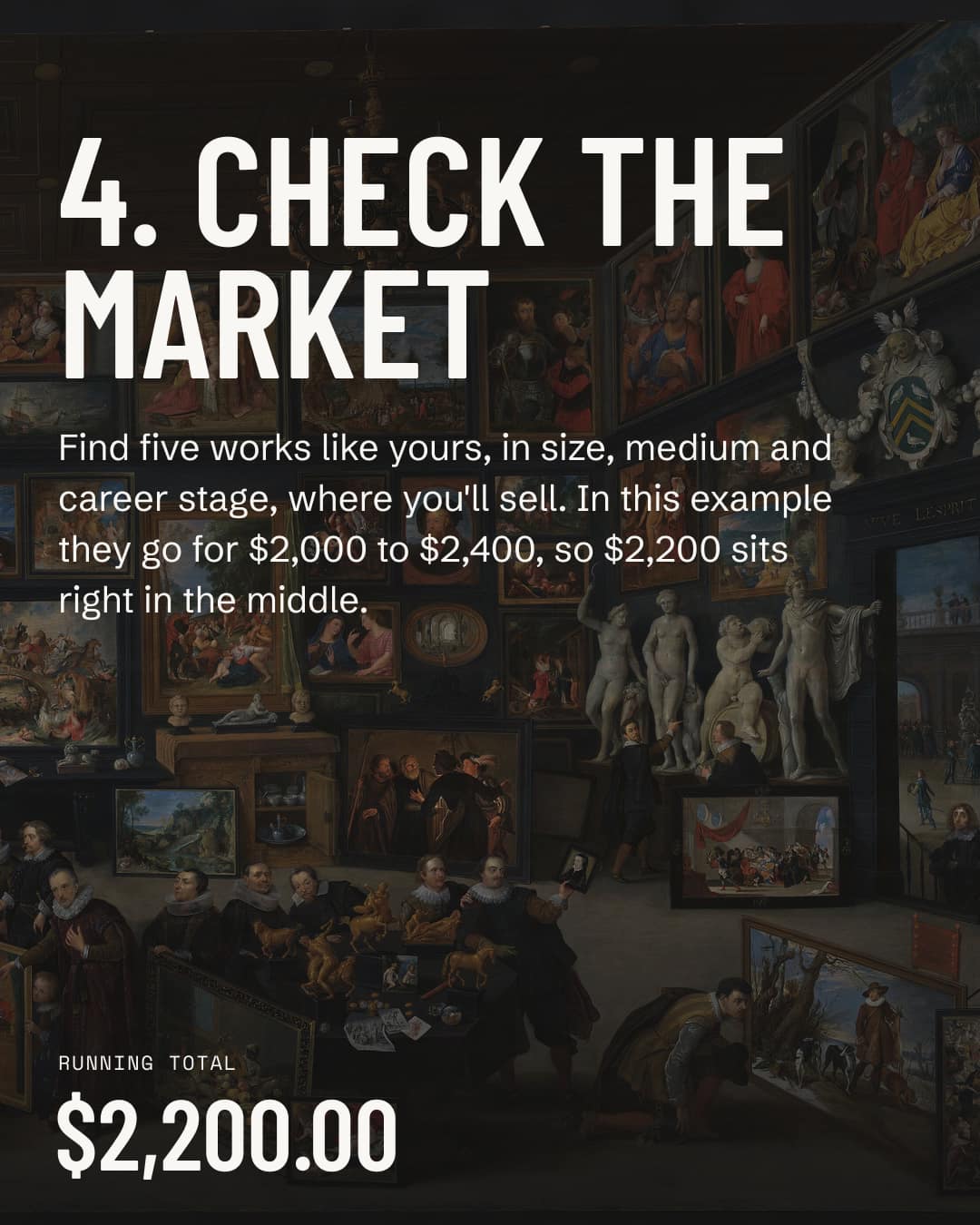
In our example, similar paintings sell for $2,000 to $2,400, so $2,133.33 rounds to $2,200.
Step 5: Keep your prices consistent
Once you've set a price, stick to it. The City of Ryde's guide for artists puts it plainly: "Always charge the same retail price across stores, markets, and open studios."
- One price everywhere. Your studio price, your website and the gallery should match. Undercutting your gallery from your studio damages the relationship, and under an exclusive agreement the gallery may be owed commission anyway.
- Price by size and medium. Once you have a price for one size, scale it for the others (see below), so buyers can see your prices make sense.
- Don't discount. NAVA says discounting by galleries "is generally discouraged", and that any discount should come out of the gallery's commission unless you agree otherwise. Arts Law's sample agreement says a gallery can't discount your work without your written permission.
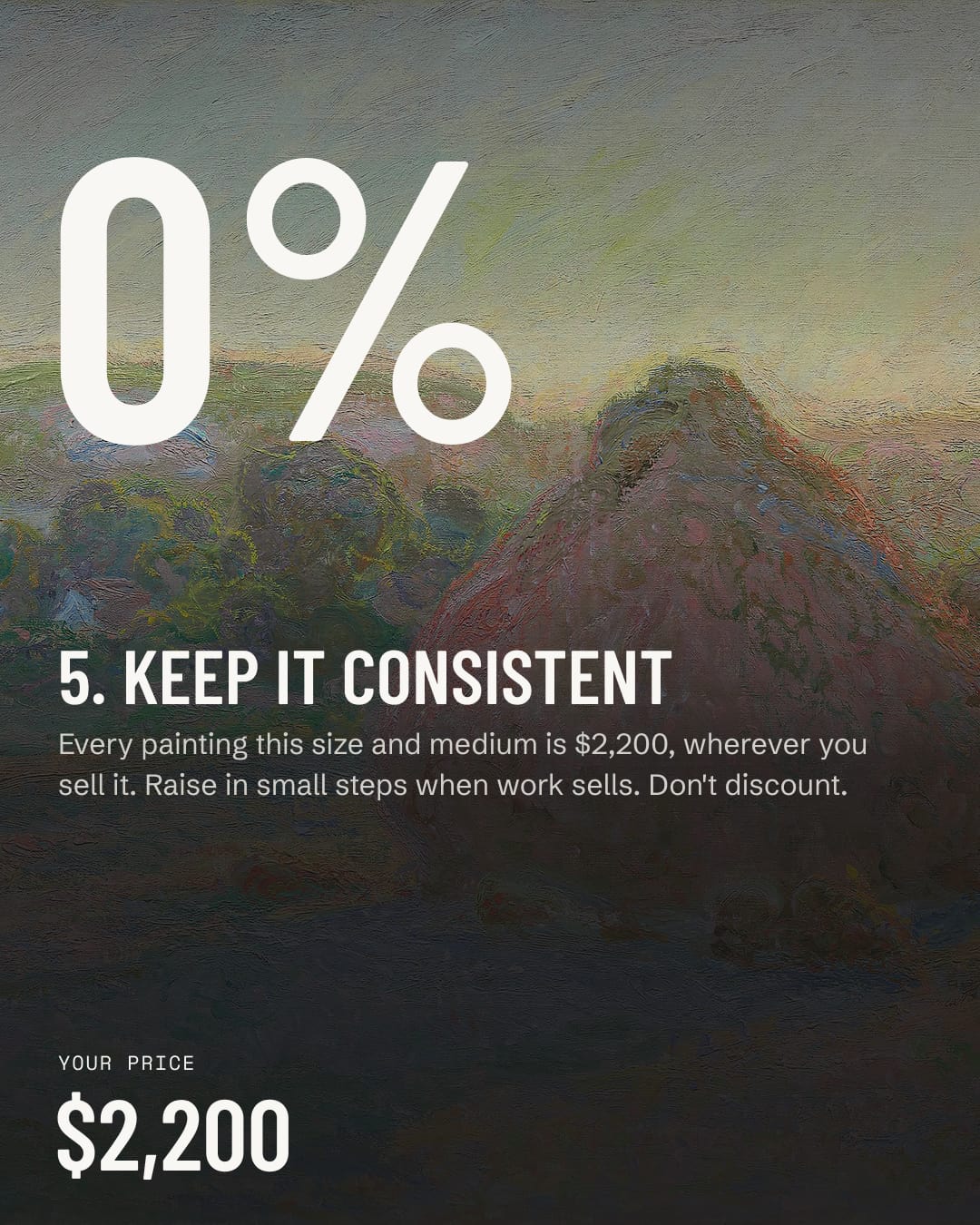
How to price art by size
Pricing by size is a common way to keep your prices consistent, though no Australian arts body sets an official formula. Two methods you'll see:
- By linear size: add the height and width, then multiply by a set dollar rate. Our example painting is 92 + 73 = 165 cm. At $2,200, that's about $13.33 per cm. A 50 x 40 cm painting in the same medium would be 90 cm x $13.33 = about $1,200.
- By area: multiply height by width and use a rate per square centimetre. Area pricing grows fast, so very large works can end up priced far above the market. Check the result against Step 4.
Whatever method you use, check the small sizes still cover your costs and time, and the big ones still sit in the market.
When to raise your prices
Raise prices when your work keeps selling at the current price, not before. The Aboriginal Art Centre Hub of WA's pricing guide says that if work is in high demand, "you can go up one small increment", and only raise again once demand holds. It warns against doubling: "then you will crash, and you can't come back."
Good times to review your prices: once a year, after a sold-out show, when a gallery takes you on, or after a major prize. Raise in small steps, and never drop prices you've already sold at.
How to price prints
Prints need their own sum: printing costs, paper, editioning, signing and packaging, plus your time and any commission. No Australian arts body sets a rule for pricing prints against originals, so use Steps 1 to 5 for each print size.
A few things to decide before you sell:
- Limited or open edition. Set the edition size before the first sale, and don't add to it later.
- Each size is its own price. Keep it consistent across sizes, the same way as originals.
- Resale royalty doesn't cover mass-produced items. Arts Law notes the scheme doesn't apply to mass-produced items such as posters.
How to price a commission
A commission is a custom work, so it costs you more time: meetings, sketches, changes. Price it higher than a similar work from stock, and get the terms in writing. Arts Law's sample commissioning agreement covers:
- A deposit or progress payments. Arts Law's checklist gives "50% on commencement and 50% on completion" as an example.
- A design fee. In Arts Law's sample agreement, the client still pays a design development fee if they reject your design.
- Changes charged "at an agreed rate".
- Copyright. You usually keep copyright even after the client owns the painting. Title and copyright are separate.
GST and your art prices
GST is 10% on most goods and services sold in Australia. Whether you charge it depends on your turnover:
- Under $75,000 a year: registering for GST is optional. If you're not registered, you don't charge GST.
- $75,000 or more: you must register, within 21 days of passing the threshold. If you don't, the ATO says you may have to pay GST on sales since you should have registered, even if you didn't charge it.
- You need an ABN to register. If you don't quote an ABN, a business paying you may have to withhold 47% of the payment.
If you're registered, your price needs to include GST, so allow for it in your sum. Galleries quote commission differently, so ask each one whether their rate includes GST. This is general information, not tax advice. Talk to an accountant about your situation.
The 5% resale royalty
Pricing well matters beyond the first sale. Under Australia's Resale Royalty Scheme, artists get 5% of the sale price when their work is resold commercially for $1,000 or more, through a gallery, auction house or dealer. It doesn't apply to the first sale or to private sales between individuals. Copyright Agency collects it, and since 31 March 2025 it also covers resales in 26 other countries. Register with Copyright Agency to receive it.
Questions people ask
How much should I charge for my art? Add up your costs, pay yourself for your hours, divide by what's left after commission, then check the result against similar work. In our example that's ($200 + $1,080) ÷ 0.6 = $2,133.33, rounded to $2,200.
How do I price my art as a beginner? Use the same sum, with a modest hourly rate that's still above the $26.44 minimum wage, and price towards the lower end of the market for your size and medium. Start sensible and raise in small steps as work sells. Pricing too high early is hard to undo.
How much commission do galleries take from artists in Australia? Commercial galleries generally take 40% to 50%, not including GST (NAVA). Public galleries take 10% to 40% or more. The art shows we checked take 30% to 40%.
Should I add the commission on top of my price? No. Divide by what's left instead. For a 40% commission, divide your floor by 0.6. Adding 40% on top leaves you short.
How do I price art by size? Add height and width (or multiply them for area) and use a set dollar rate, so every size is consistent. Then check small works still cover your costs and big works still sit in the market.
Do I need to charge GST on my art? Only if you're registered for GST. You must register once your turnover reaches $75,000 a year. Below that it's optional.
Is there a pricing artwork calculator for Australia? The sum in this guide works as one: (materials + studio costs + hours x rate) ÷ (1 − commission). Run it once per size and medium, and keep the results as your price list.
Can I sell my art cheaper from my studio than in a gallery? It's best not to. Keep one price everywhere. Undercutting your gallery hurts the relationship, and under an exclusive agreement the gallery may still be owed commission.
Keep going
If you need money to make the work in the first place, see our guide to art grants in Australia 2027. For time and space to make it, there's artist residencies in Australia 2027.
Sources
- NAVA Code of Practice: Commercial galleries and representation, Public galleries selling work and Payment Standards
- Fair Work Ombudsman, Minimum wages
- ATO, Registering for GST and Statement by a supplier not quoting an ABN
- Arts Law Centre of Australia: consignment agreement notes, commissioning agreement notes, Design checklist and Resale royalty
- Australian Government, Resale Royalty Scheme
- City of Ryde, Pricing your art or creative product
- Aboriginal Art Centre Hub of WA, Pricing and the art market
- Art show terms: Camberwell Art Show, Gosford Art Prize 2026, Muswellbrook Art Prize 2025/26, Lethbridge Small-Scale Art Award 2026, Tattersall's Landscape Art Prize 2026
All checked 10 November 2026. Rates and rules change, so check the source before you rely on a figure.
Image credits
All paintings are in the public domain, via Wikimedia Commons. Johannes Vermeer, Girl with a Pearl Earring, c. 1665, Mauritshuis, The Hague. Johannes Vermeer, The Art of Painting, c. 1666 to 1668, Kunsthistorisches Museum, Vienna. Vincent van Gogh, Self-Portrait, 1887, Art Institute of Chicago. Willem van Haecht, The Gallery of Cornelis van der Geest, 1628, Rubenshuis, Antwerp. Claude Monet, Stacks of Wheat (End of Summer), 1890 to 1891, Art Institute of Chicago. Vincent van Gogh, Sunflowers, 1888, National Gallery, London (in the carousel graphics).
Related
Art grants in Australia 2027
Every grant, fellowship and travel fund an Australian artist can apply for in 2027: who can apply, how much, and when each round closes.
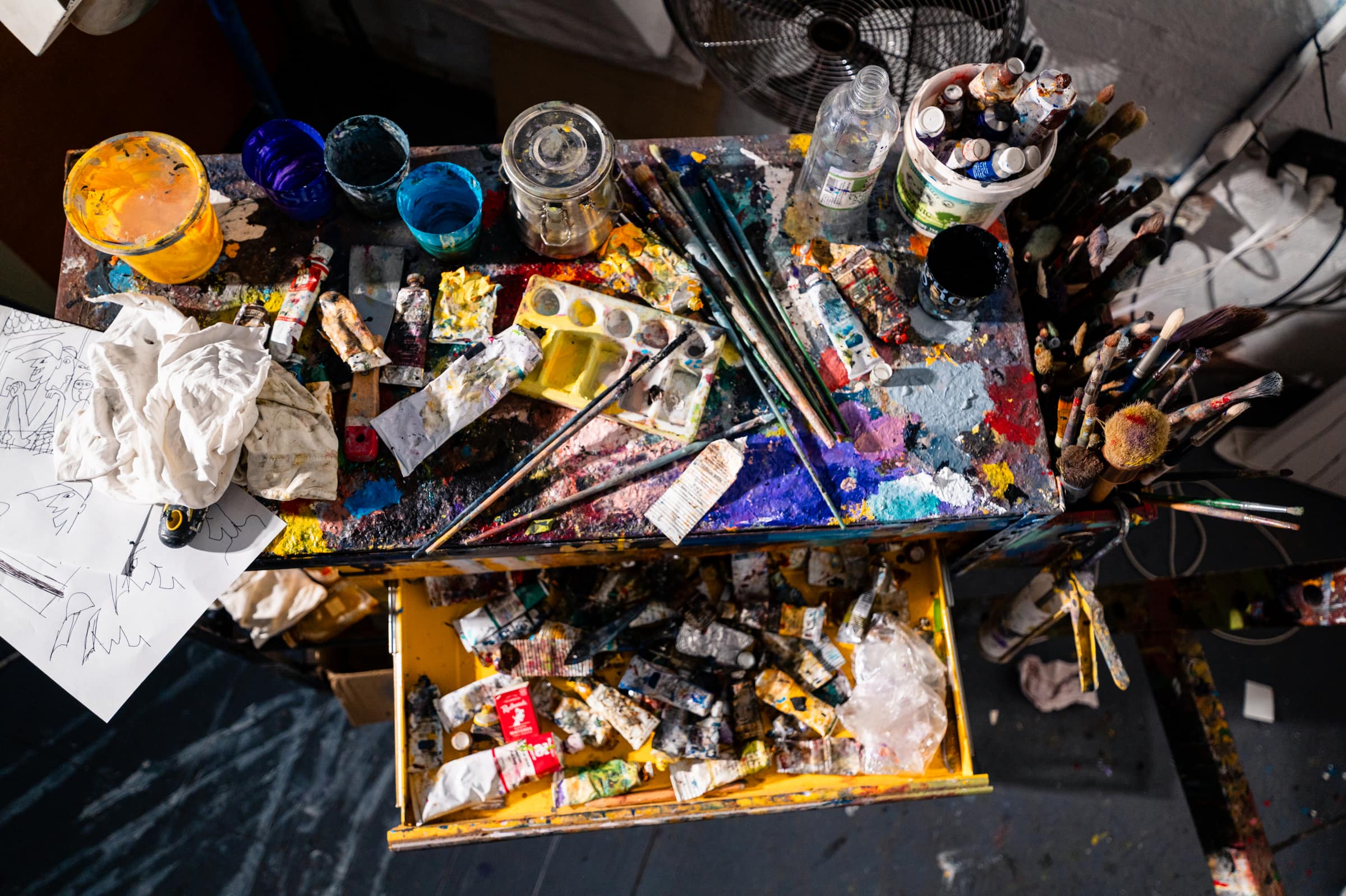
Art prizes in Australia 2027
Every major Australian art prize for 2027: entry dates, fees, prize money and who can enter.
Film developing in Melbourne: every lab, price and turnaround
Every lab, darkroom and drop box worth knowing, with prices, turnaround and what each one develops.
Artist residencies in Australia 2027
Studios, stipends and time away: Australian artist residencies for 2027, what's still open, and when the 2028 rounds open.