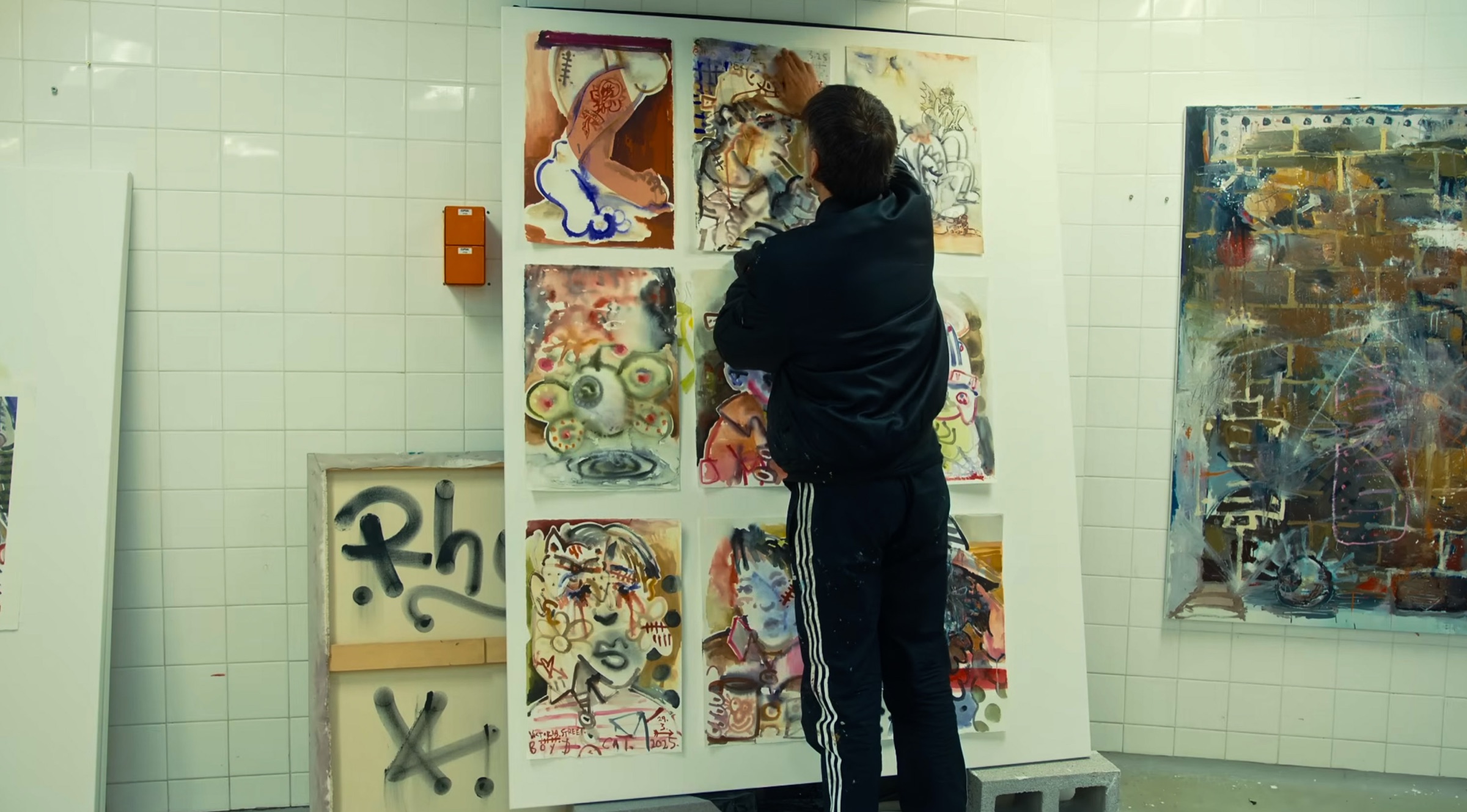
Inside the Epic Studio of an Abstract Artist
Rhys John Kaye lost his sight in Japan, then lost 15 years of belongings in a truck fire. He came back to the studio with an endless energy to paint.
“My work has always been responsive to my life. It was definitely going to find its way into the work.”
Loose and quick
When Rhys John Kaye gets into the studio, the first thing he does is rip up some paper. “I rip a few of these up and do something kind of loose and quick on them,” he told me. He might do 10 to 15 of them in a week.
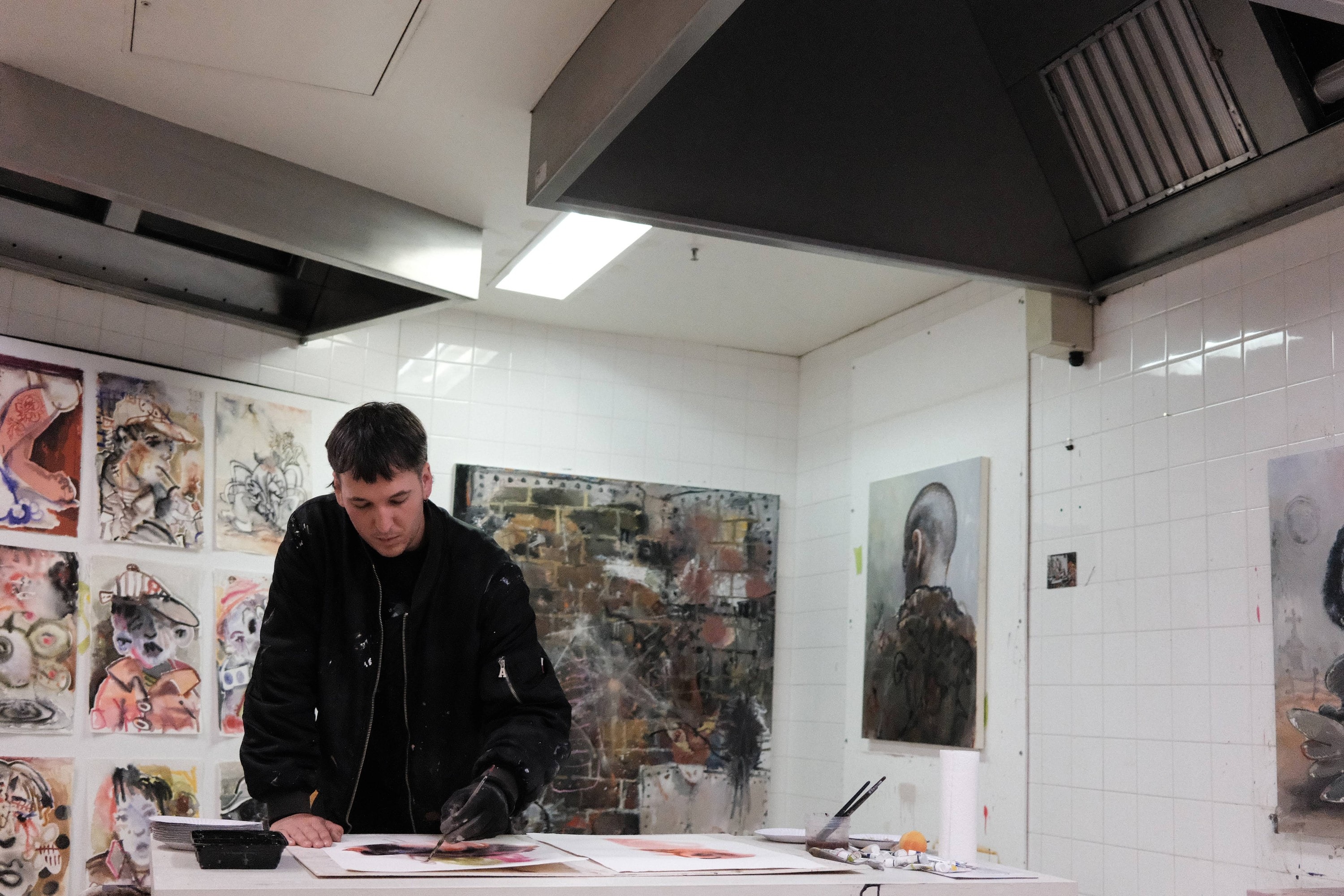
From there, he starts to notice things. “I’ll take elements of each thing, or I’ll start to see patterns within these works that I want to focus in on.” Those patterns lead into larger scale paintings.
The morning I visited, there were about 10 police cars across the road. There had been a stabbing in the mall. Rhys didn’t want to dwell on it, but he did explain what the small works are for on a day like that. “Doing this work now is almost a way for me to archive the thought or the memory,” he said. “It’s an honest reaction to what I’m internally experiencing.” After that, it is up to him whether to take it further, share it, or just process it and move on. “It’s a pretty intense thing to wake up to on a Saturday morning.”
The south of Japan
About seven months before we filmed, Rhys went to the south of Japan. He was somewhere isolated, in the mountains below Fukuoka, working at a ceramic studio and keeping a painting studio of his own.
Then he got sick in the village, sicker than he realised. “I damaged some nerves behind my eyes, in my brain, and then I started to lose my vision.” He recovered, but his sight didn’t. He described it as that moment when you first wake up and your eyes haven’t adjusted yet, except it lasted all day.
The doctors couldn’t promise anything. Because it was nerve related, he was told, it could be fine tomorrow or it could stay for the rest of his life. Walking down stairs was hard. That lasted about six weeks.
He kept trying to paint through it. “I think I was being very optimistic. I didn’t take it very seriously. I was like, oh, this is going to be fine.” But each day it went on, the doubt crept in. “In the back of my head: maybe this is more serious than I’m realising.”
“I almost lost the opportunity to paint, and I felt like I had so much in me that I hadn’t released.”
A second chance
When we spoke, Rhys had been able to see again for about 12 weeks. He went straight back to the studio. “I had a new lease on life, essentially, and was really energised to make work, because it was like a second chance.”
The paintings changed. They got looser and quicker. “I felt this urgency of, like, mortality,” he said. It also made him question things he hadn’t thought much about before: abstraction, figuration, realism, and where his work sits between them.
The truck
Then came the second blow. Rhys came back to Australia to recover, and while moving his belongings out of a storage shed and into a new house, the removal truck crashed and caught fire. “We lost everything.”
Photo albums, keepsakes, furniture, art he had collected from other people, sketches, hard drives full of photos. Everything sentimental or personal from the past 15 years, put into storage to keep it safe. “Which ultimately backfired.”
He held out hope that some of it might only be damaged. Then he got to the container where everything from the crash had been put. “It was just pieces of broken wood.” He took two planks that had come off the back of a couch a friend built him.
What surprised him was how he took it. “Losing my eyesight really scared me. And then this happening. I think if it happened the other way around, I probably would have been more bothered.” He was careful to say it was devastating. “Don’t get me wrong. But I didn’t react the way I thought.”
“There’s a lot of good that came from it.”
Endless energy
Now, he says, his work is slowly unravelling, and these events are showing up in it. “It feels exciting because there’s so much going on. I’ve got this endless energy to paint.”
He wasn’t stuck before. He had plenty of motivation. But this forced him to reconsider everything, and he thinks that was a good thing. “I probably wouldn’t have spent the time otherwise unless I was forced to, and I wouldn’t have had the same outlook if I didn’t experience what I experienced.”
Eighty or ninety per cent
His way of finishing a painting is to not finish it, at first. He gets a work to about 80 or 90 per cent, then steps away. Coming back to it later is when he decides how to finish it, or what is really going on in it. “That’s usually the point where I either destroy it or try and resolve it.”
One painting had already shifted under him. “Originally, I was trying to paint a portrait of myself witnessing what I witnessed,” he said. Now, he thinks, it is a painting of himself feeling uncomfortable at having to tell me about all of this.
Related
Artist Studio Visit - Angharad Neal-Williams
Flat colour, quirky lines and imagined worlds.
The Collage Artist Who Nearly Died at 36
Ripped paper, cut letters and a second chance.
The Painter Who Started Painting to Heal
Painting as therapy, and as something to leave behind.
Why I Left Tattooing to Pursue My Passion for Painting
From the tattoo chair to the painting bench, chasing the fun.