Why a Melbourne painter can't stop painting cartoons
Liam Seear-Budd has hung next to KAWS and Andy Warhol, and most of his work sells overseas. Most days, he's at work as a screen printer. His paintings are bright and loud. The reason he paints them is quieter.
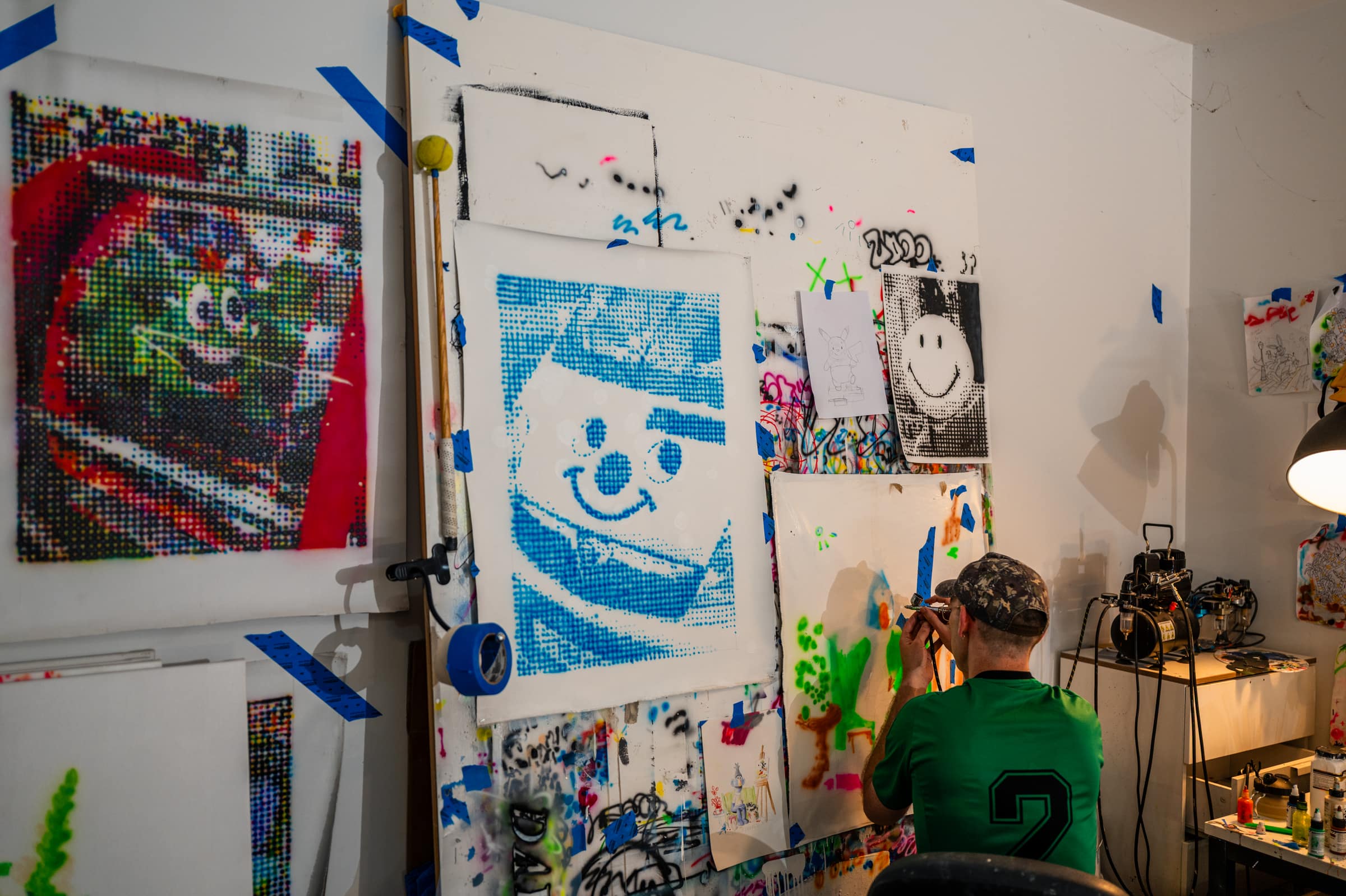
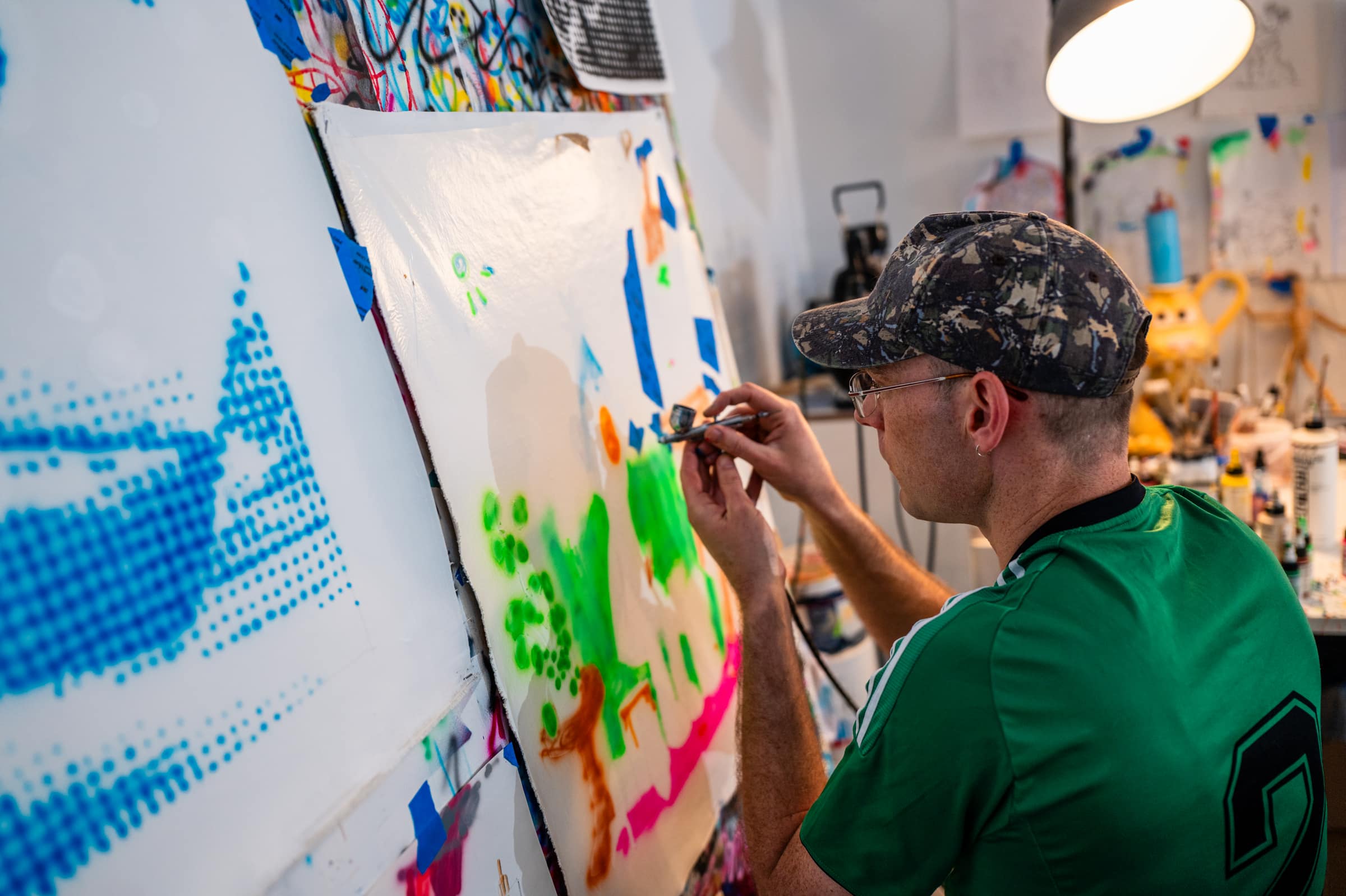
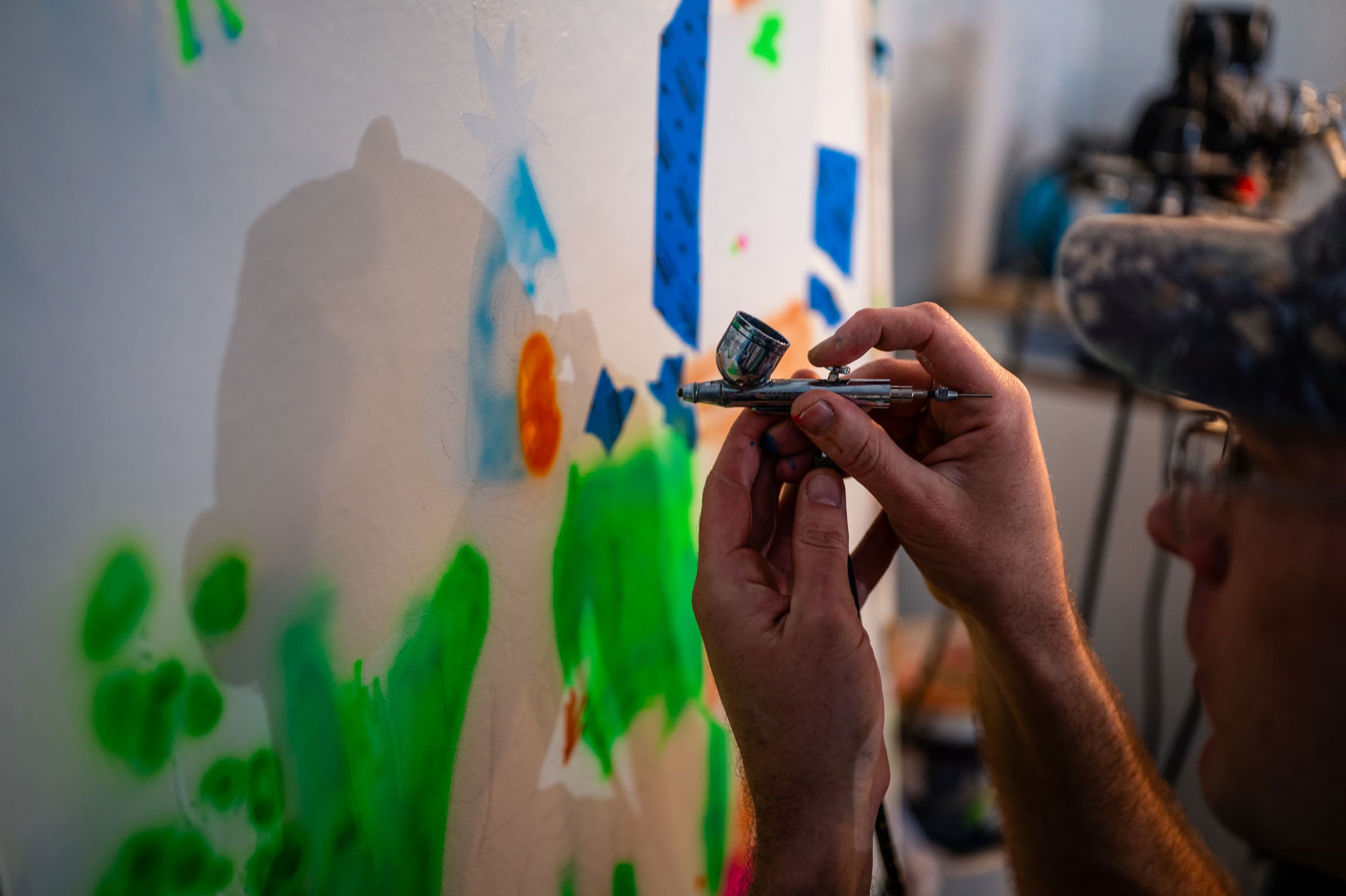
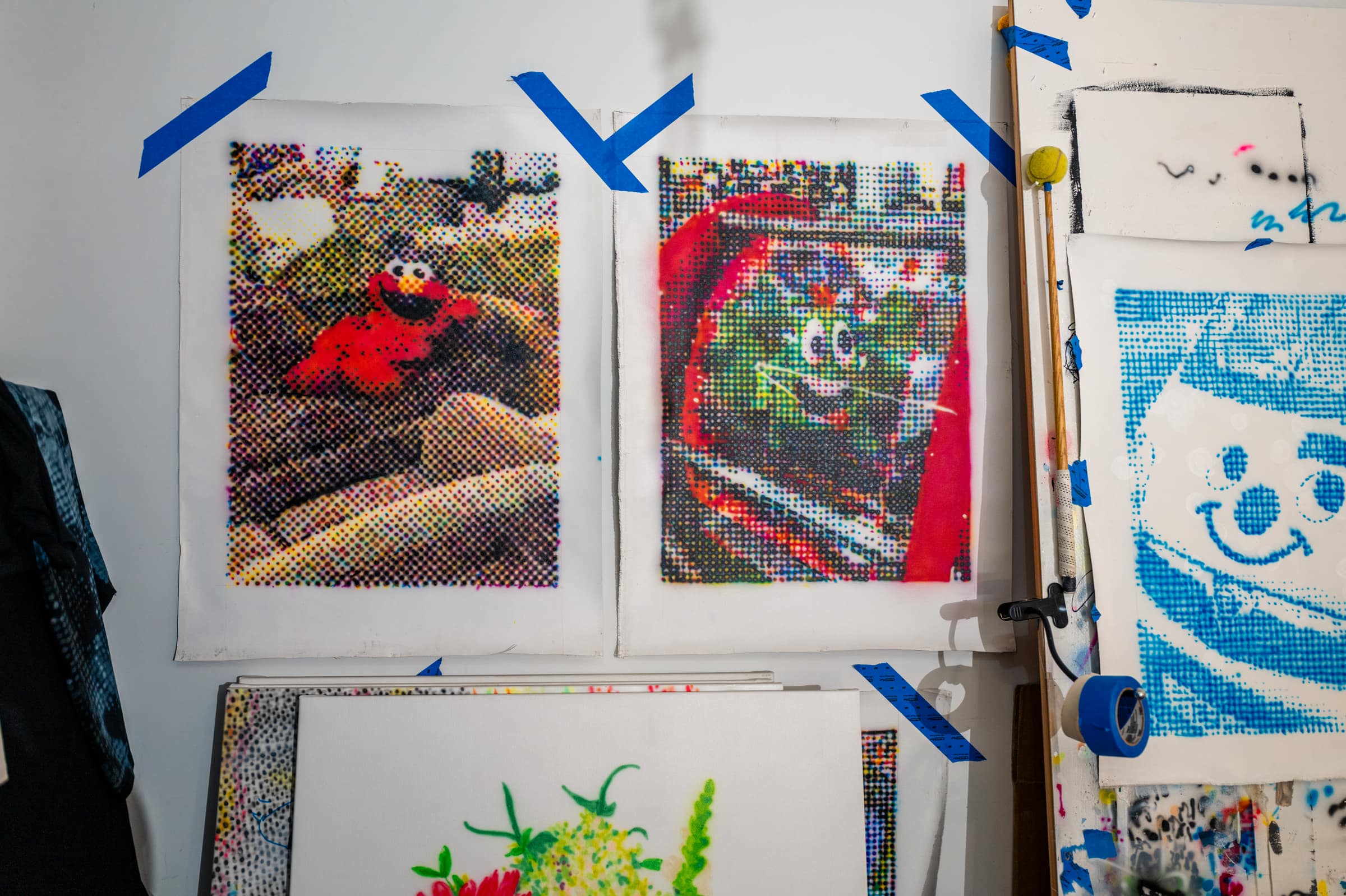
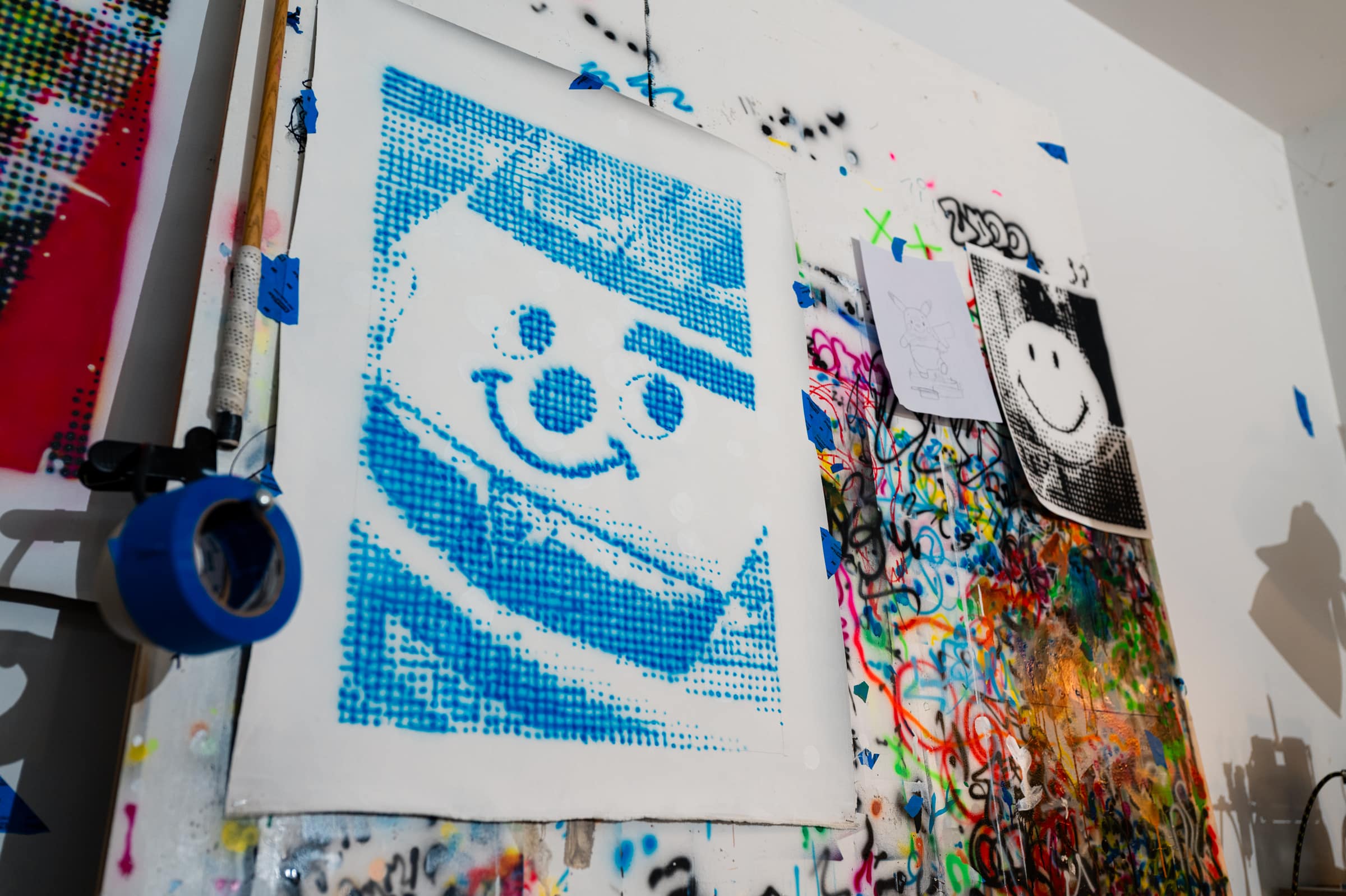
The wall behind Liam Seear-Budd's desk is covered in work. A clown face in blue halftone dots. Elmo, broken down into cyan, magenta, yellow and black. A black and white smiley face. Taped beside them is a sheet of plastic where something new is coming through in fluoro green, one pass of the airbrush at a time.
Everything about it is loud. That's on purpose. "I want a wall to pop out at you," Liam says. "I want to bring colour into the world." But the cartoons on that wall come from somewhere much quieter, and it took him years to work out where.
Paint like a designer
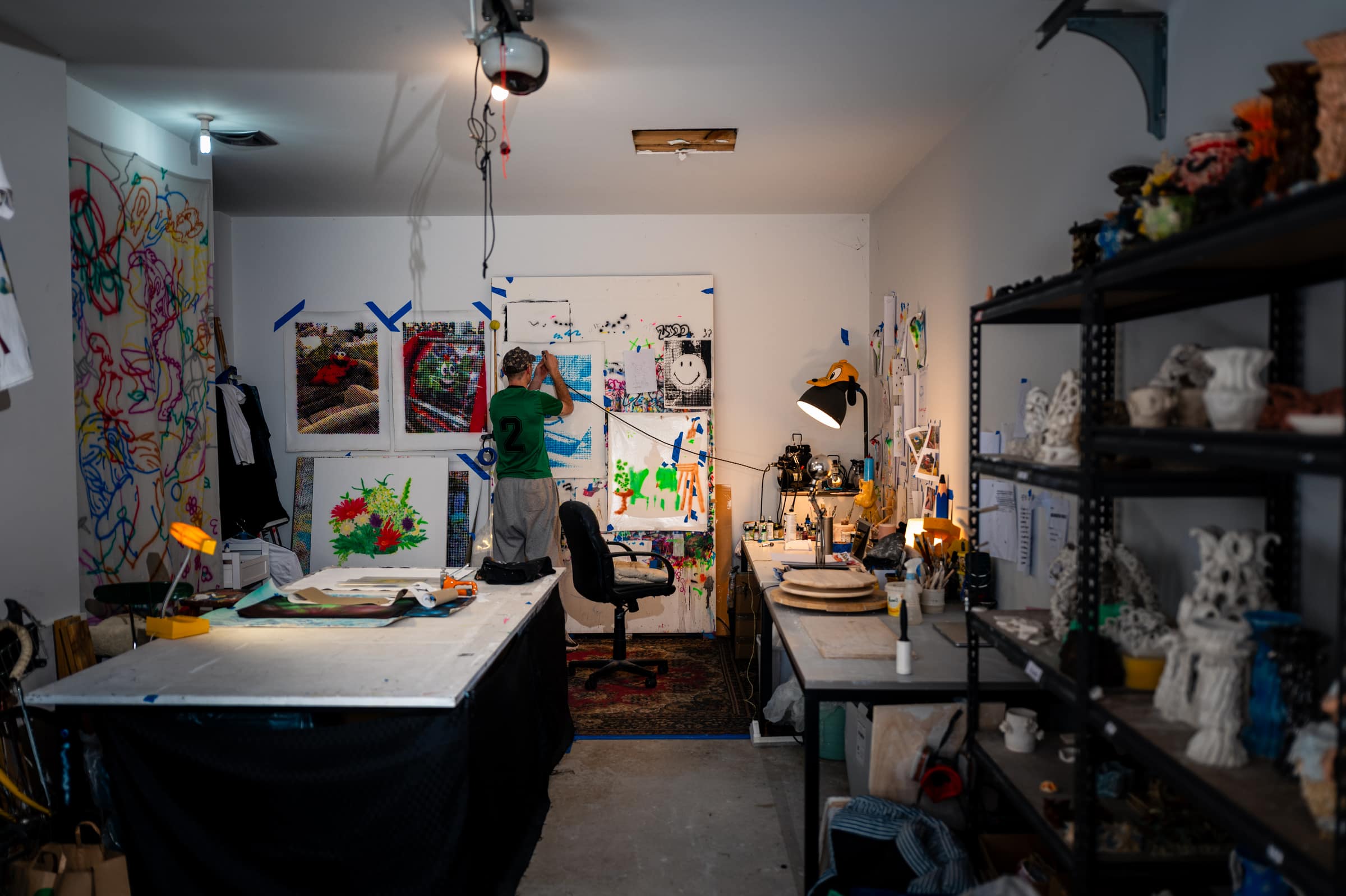
Liam grew up in New Zealand and lives in Melbourne now, where he works as a screen printer. His work these days is airbrush-based, multicoloured, and almost always on a white background, so it jumps. He can't paint in a narrow palette. "I can't paint in like all blues or something," he says. "I very much so need multicolour."
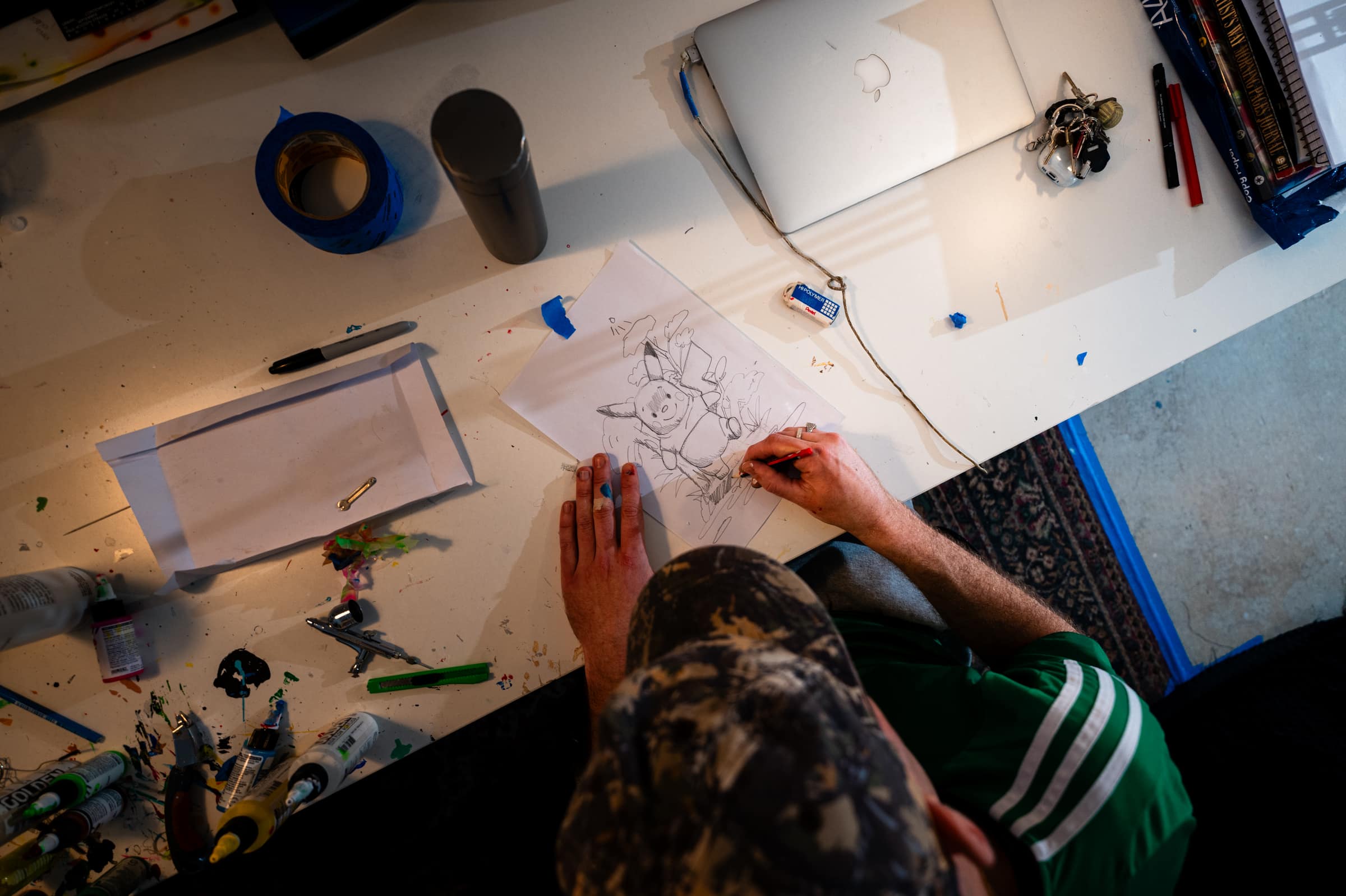
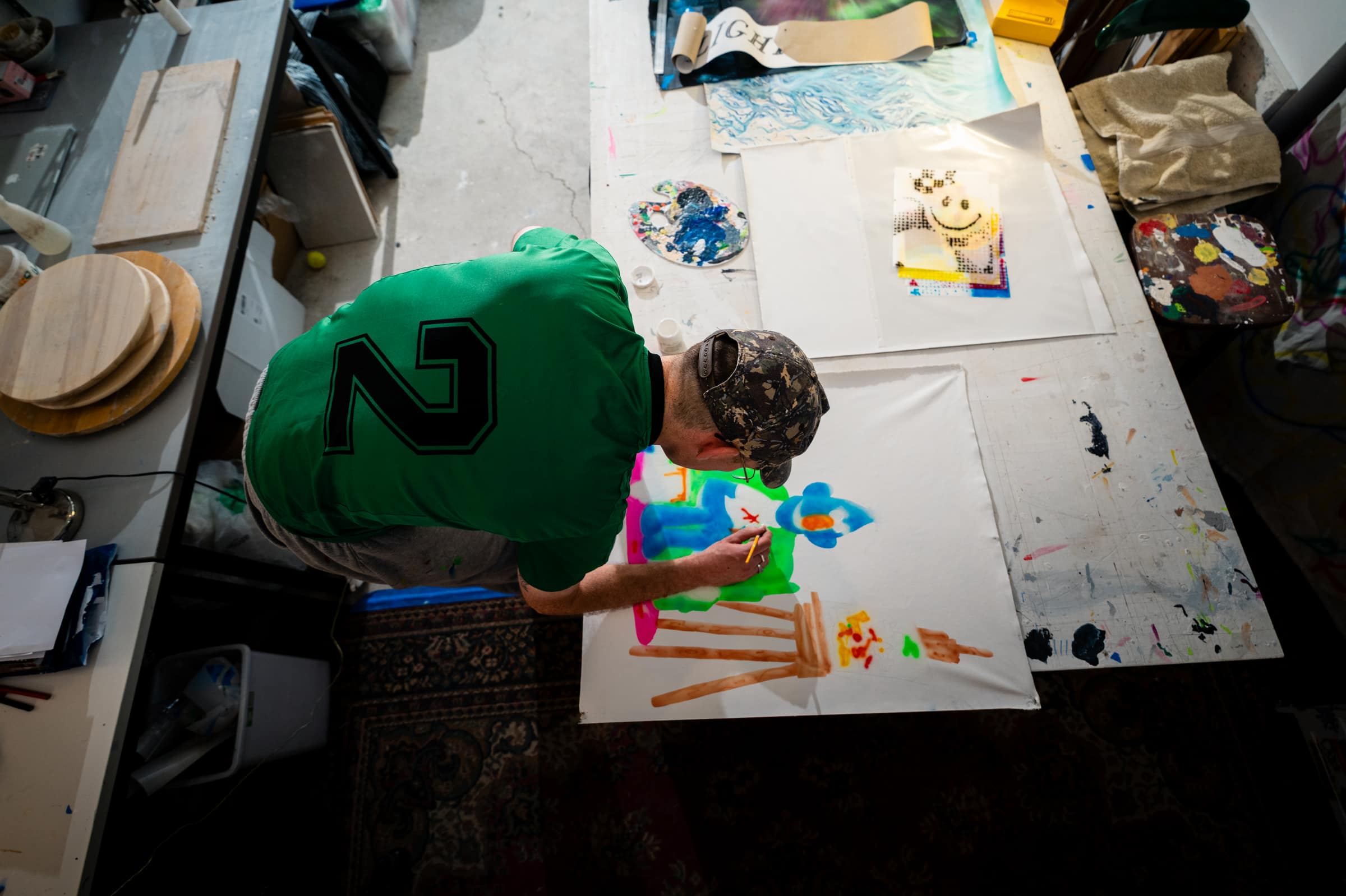
He describes his process as the opposite of free-flowing. "I like to describe it as I paint like a designer," he says. "Nothing's really ever not pre-planned." Every painting is designed, sketched and coloured before the airbrush comes out. "All of my paintings could just be graphic design," he says, "but I want a physical thing at the end of the day."
He calls design his natural talent, and painting something he forced himself to learn. He used to see the planning as a weakness, because he finds it hard to put a canvas up and just start. Now he calls it his superpower. He needs a reason to paint, an idea or a whole show, and once he has one, he can work for months.
Next to KAWS
His style keeps moving. "I sort of have like almost a year-long lease on a style," he says. He enjoys it, pushes it a bit further, and it turns into something else. "Which is sometimes like a no-no in the art world," he admits, "but there's no way I can stay on the same thing."
It's working. In 2025, Affenfaust Gallery in Hamburg reached out and asked him to be part of Knotenpunkt, a group show of about 40 artists. "They reached out to me, which is always weird," he says. "I don't know how these opportunities come to me sometimes." He flew over for it. When he walked in on the first night, they'd hung his work in a line with KAWS and Andy Warhol. "It didn't make any sense to me at all," he says, "but pretty cool." He sold a couple of works.
"I find it hard enough to get a show in Melbourne," he says. Most of his sales go to the US, and he's starting to think Melbourne might not be the place for his style, "at least at this point."
Saturday mornings
The cartoons go back to the start. From about four until seven, Liam's life was Saturday morning cartoons. "Rocket Power, it was all of them," he says. As an adult he's gone back and researched what he used to watch, digging up characters he'd forgotten, like the ones from Codename: Kids Next Door.
At first, he thought it was comfort. Cartoons were something he knew, so they were what he felt at ease painting. His first show, in a hair salon back in New Zealand around 2010, was all cartoons. Then graffiti came in, and with it a new way of working. "Those two combined, it was like, cool, now I can paint."
It took him longer to see the rest of it. When Liam was seven, his mum passed away.
“It's more than nostalgia. It keeps me in that seven year old world.”
He's slowly understood more and more about why he paints what he paints. He talks about "trying to hold on to that period of time," and about feeling comfortable in it. He doesn't want to copy the characters he grew up with. He wants them just out of reach, familiar but not quite recognisable. "I want to have the feeling of nostalgia," he says, "more than the blatant, in-your-face nostalgia."
Happy on top
So the work is never as cheerful as it looks. Liam wants people to feel the happiness of nostalgia, and then something else. "Sometimes those are very sad," he says, "or at least like melancholy."
“Might look happy, but it has an essence of sadness underneath it.”
He thinks the cartoons he grew up on worked the same way. "I think cartoons in general always had an underlying meaning," he says. Each episode had one simple lesson for the kids watching. "Kind of want to do the same thing, but have an emotion of mine that I'm portraying through the work."
Most of his buyers are adults, and he has a theory about why. "Potentially they have a similar situation to me, where they're trying to grasp onto their childhood." Not all of them, though. "People do buy stuff for their kids' rooms and things like that," he says. "So that's cool."
The day job
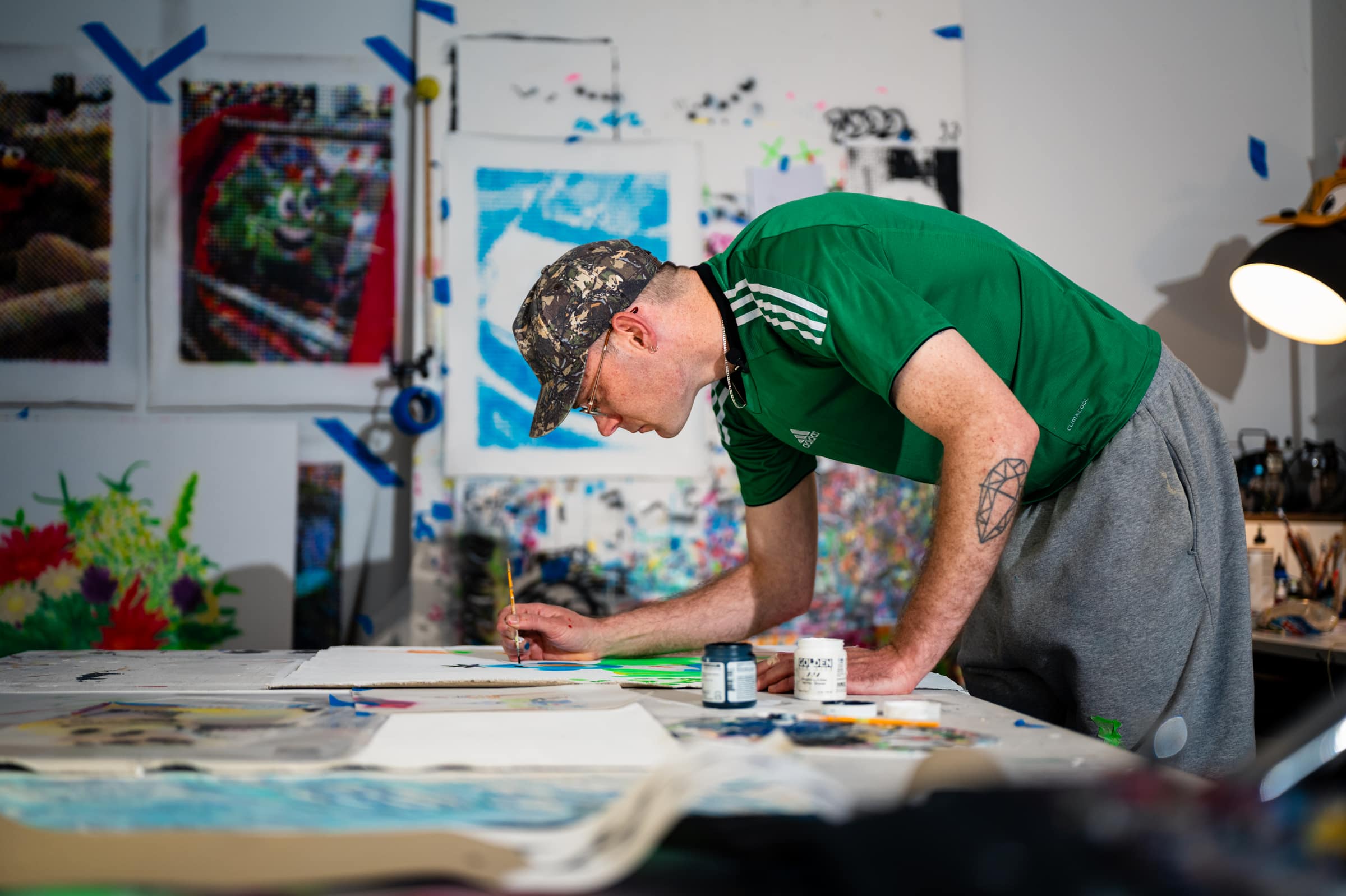
Does he paint full time? "I wish," he says. "There's been periods."
After Hamburg, he travelled through London and Paris and met an artist who was doing it full time and doing well. He came home ready to quit his job, move into a cheap house and go all in. That wore off quickly. "You realise money's got to come in," he says. He had to get his head around the idea that it might not happen for a while, and be happy to keep working at it anyway. "Life as an artist is not easy," he says. "I'm here for a long time."
Now, if he works four days and paints two, that's fine. He paints in the evenings, which is exhausting, and he gets by with a lot of planning. Because the ideas are all written down, he doesn't have to catch a mood when it hits. "I've gotten pretty good at just writing heaps of lists of things," he says. "Lots of lists."
The strange part is the gap between how it looks and how it is. He recently had work in a Sonic the Hedgehog 35th anniversary show in the US, and went back to the day job the next morning. "It's still weird to have these opportunities," he says, "but be stuck in the same kind of situation I've been in for 10 years." When work goes to a show overseas, he pays to ship it, and sometimes never even sees a photo of it on the wall. On Instagram, he says, "I probably look like a full-time artist." Some days, it's "a classic imposter syndrome feeling."
Halftones
The day job has found its way into the paintings. From screen printing, Liam has developed what he calls his CMYK paintings: images painted in halftone dots, layer by layer, the way a printer would print them. "Boring, very boring to paint," he says, "but satisfying at the very end." It's a look you don't see often in painting, and one he wants to push.
Smiles and Seven
He's working on two new bodies of work, slowly. The first started when he couldn't find a concept for his next show. He'd always wanted to paint from his own photos, so he went through his camera roll. "Literally like 95% of them were all cartoon smiles," he says, many taken at a time when he wasn't feeling great. "Without me even trying, I just came up with a whole show concept."
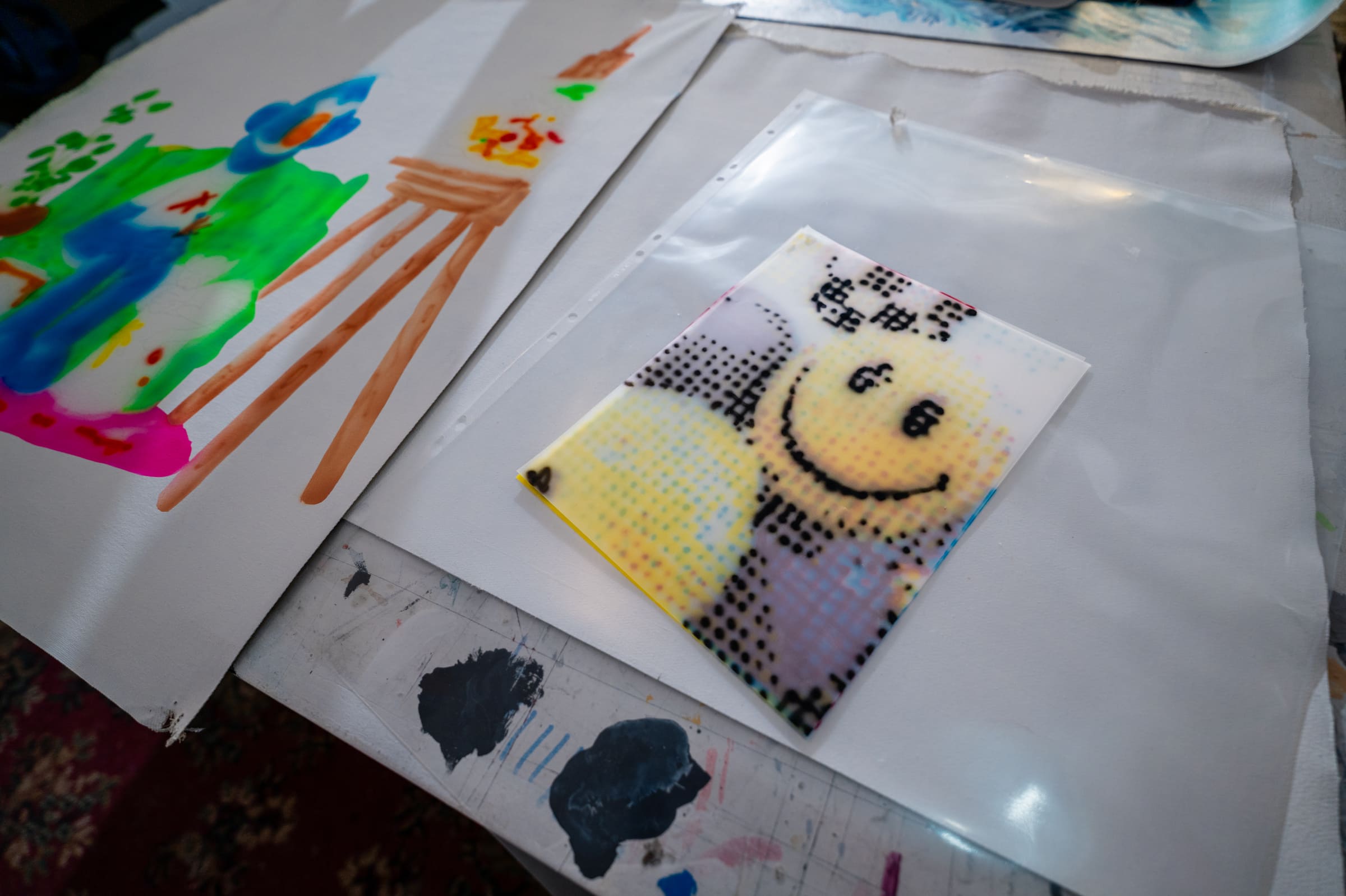
The second is called Seven. It's about the first seven years of his life, before his mum passed away. The flowers on the table when he was brought home from hospital. Photographs of his family. Poems from his mum. It's been, he says, about "trying to create more meaning, I guess, to myself behind it."
He's in no rush with either. "I'd be happy if I spent another year on each of them," he says. Sometimes things in the past have felt a bit rushed.
Reflection, he says, is "pretty much the whole thing." Most of his paintings start with a memory, or a feeling from a big change in his life. "Reflection is nostalgia, essentially," he says. "You are just reflecting back on those times, and feeling those feelings from back then."
Hold on to it
Strangely, finishing a painting isn't the best part. By the time a show opens, he's usually sick of the work. He's spent too long with it, planning, sketching, choosing colours, following the process. He's proud, he says, but a finished painting is "just a tick on my list."
“It's more of the process doing it. It's more of the therapy for me.”
Asked what nobody told him about being an artist, Liam doesn't take long. "You're gonna be in it for a while," he says, "so have some patience." Hard work beats talent, in his opinion. And whatever happens, keep the thing that got you started.
"Ambition's that sweet juice that slowly kind of deteriorates over time," he says. "So hold on to that ambition."
See more of Liam's work at liamseearbudd.com and on Instagram at @liamseearbudd.
Related
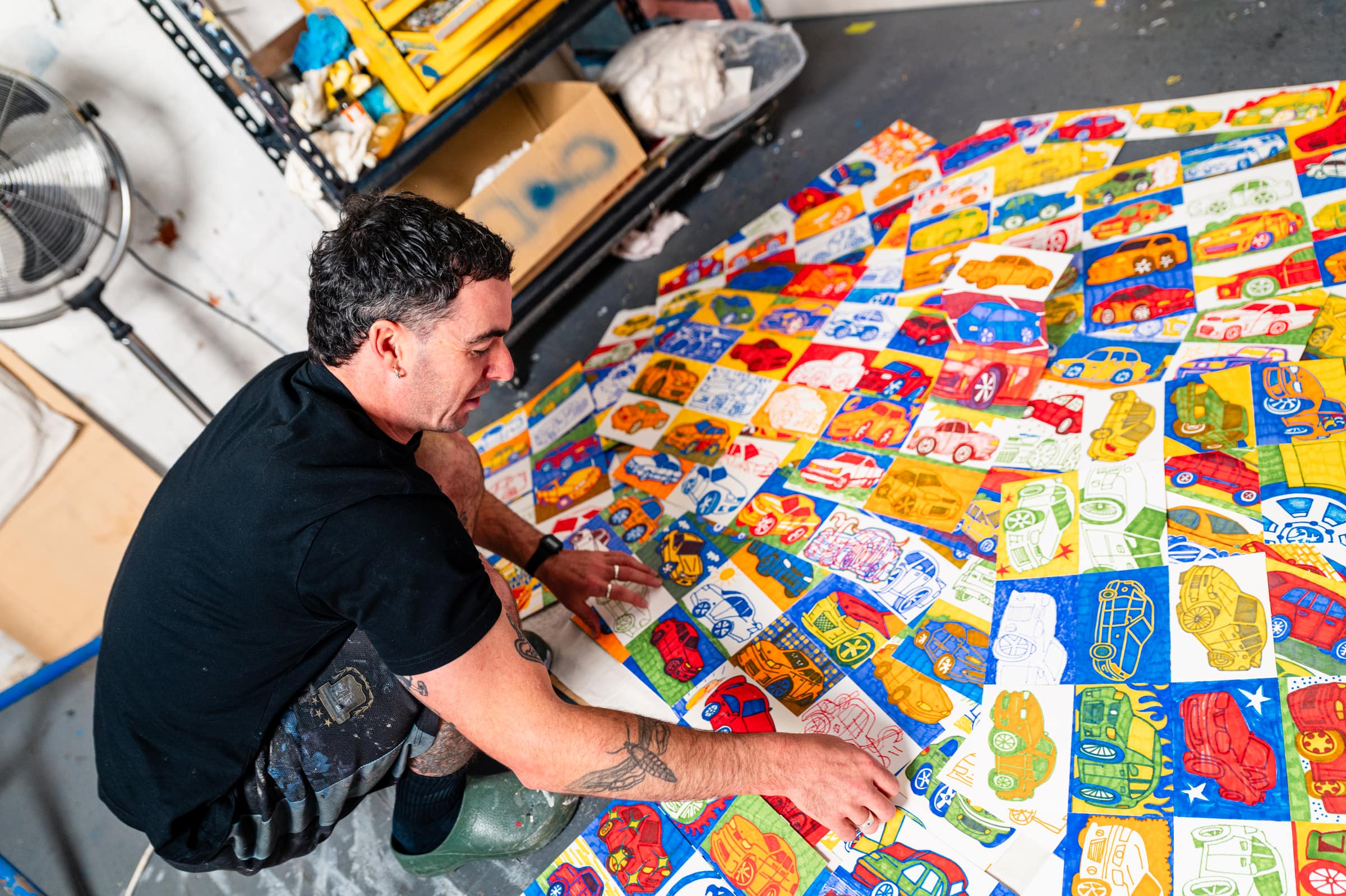
He drew Victoria's most stolen car 1,000 times
Three and a half years teaching art in youth justice, then a thousand Holden Commodores in six textas.
The Painter Who Started Painting to Heal
Painting as therapy, and as something to leave behind.
He Never Trained As An Artist. Now He's In The National Gallery.
Drawing as magic, play as a practice.
Inside the Studio of Painter Christopher Myles Henderson
A thousand Commodores, six textas, and the boys he couldn't stop thinking about.